Multi-Modal Analyser
Multimodal research analysis that looks deep below the surface
Upload transcripts, survey data, open ends and prior waves. The Multi-Modal Analyser reads it all as one set, finds the hidden connections and true insights your clients need, and traces every finding to its source.
Built for market research agencies · Never trained on your data
The problem
Your clients need deeper insight, not summaries
Every AI tool can now summarise a data set in seconds. But a summary reports the average, and your clients already have the average: it is on their dashboards.
Insight sits at the edges: the tension, the absence, the single remark that explains the pattern. That is what clients pay an agency to find.
80%
of a researcher’s time goes on into preparing and organising data, leaving 20% for analysis and insight.
Source: Forsta, 2025
Three readings of the same data
Summary
What the data says
Customers are broadly happy but want faster support.
Finding
A fact the data shows
Younger customers rate support far worse than older ones.
Insight
What is actually going on
Younger customers do not want faster support at all: they want better self service tools so they can fix issues themselves
Illustrative example
Multi-modal data analysis
Our Analyser finds the insights across data sources
Upload data as you hold it, with no templates or pre-work. The Analyser holds the whole data set at once.

Qualitative
- Interview and focus group transcripts
- Relevant qual from other studies and sources

Quantitative
- Survey data tables and cross-breaks
- Tracker waves
- Segmentation outputs

Context
- Open-ended verbatims
- Client documents and sales data
- Social listening and previous studies
Upload as
Word
PowerPoint
Excel
SPSS (coming soon)
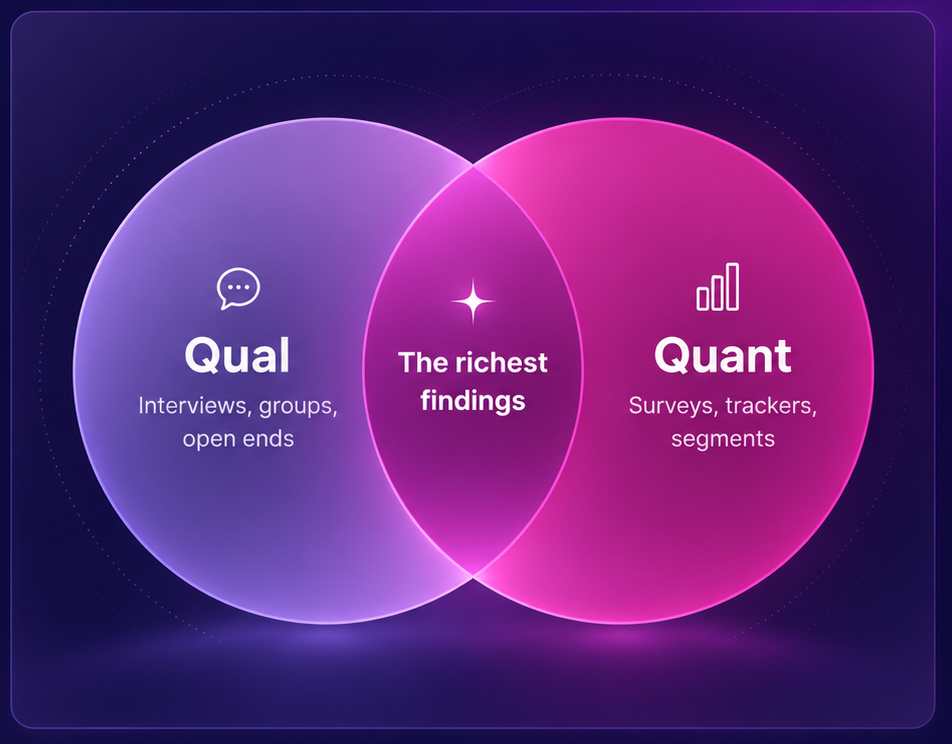
Integrated qual and quant analysis
Qual, quant and both together
The Analyser handles a set of interviews on its own, a survey on its own, and the two together.
The last matters most. The richest findings often sit where qual and quant meet: a pattern in the numbers explained by something said in the interviews, or a claim in the interviews tested against the survey. Analysed separately, by different people in different decks, those connections are rarely made.
“Statistics for mixed data. For decades we had tools to find patterns in numbers, and nothing for numbers, words and images together.”
Beneath the surface
Examples of the clues our analyser is trained to hunt for
Generic AI tools skim the surface of your data.
Great researchers look below it, using their experience to dig deeper and spot the clues that lead to insight.
Our Analyser is built to read your data the way you do, through a series of insight lenses we have trained it to use.

Tensions and contradictions
Between what people say and what they do, within one respondent or between segments.

The single voice that matters
The remark made once that outranks a pattern across four hundred, flagged rather than averaged away.

Absences
What is conspicuously not said, chosen or mentioned. If nobody names the market leader unprompted, the silence is data.

Hidden splits
Segments whose views cancel each other out in the total, so one flat score hides two stories.

Connections between sources
Qual against quant, this wave against the last, open ends against closed questions, tone of voice against the words.

Early change
The drift that shows before it becomes a trend: a new phrase creeping into open ends, a small segment moving ahead.
Each clue is a lead for your researchers, not yet an insight.
Traced to its source
Every finding traced to its source
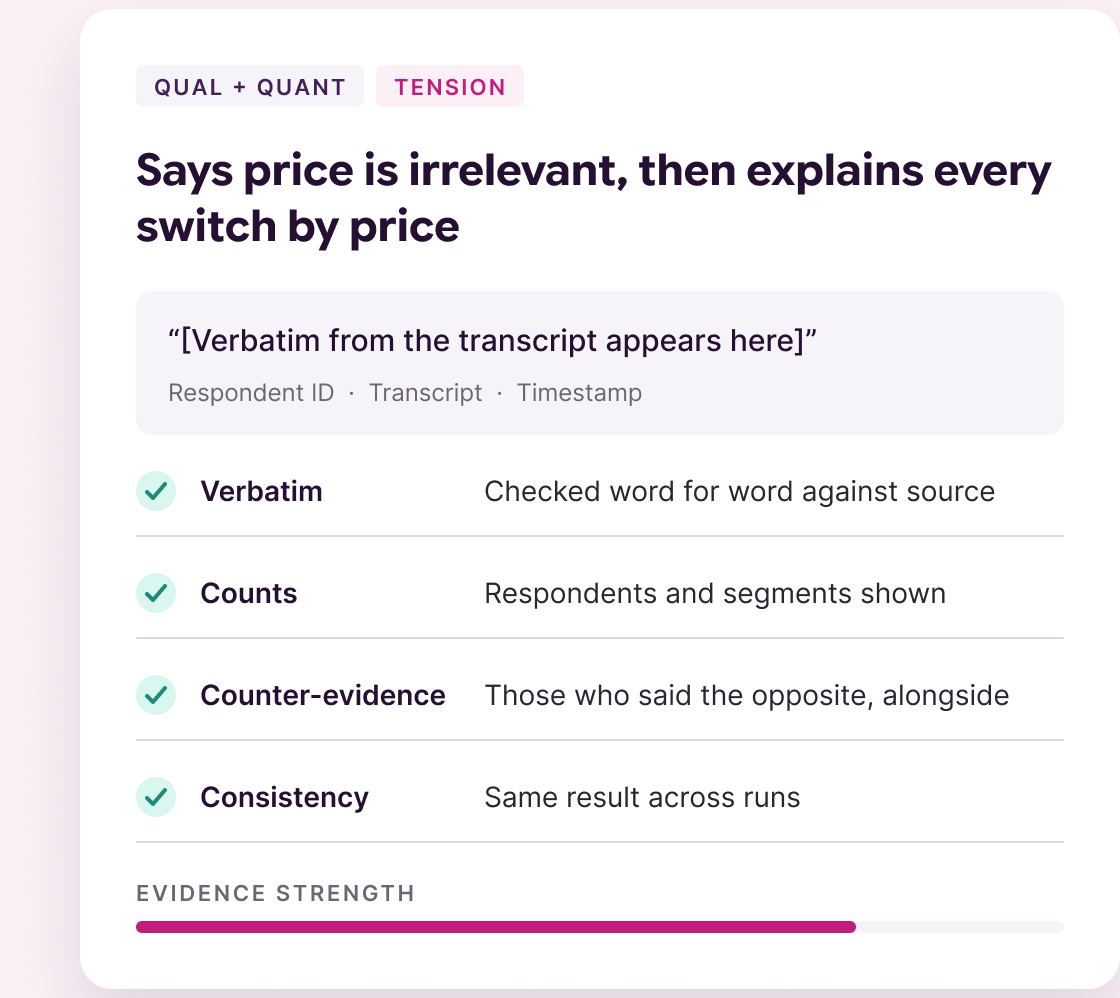
Generic AI tools make mistakes even with the data you upload: a misread table, a figure pinned to the wrong segment, a quote nobody actually said. The Analyser is engineered to minimise hallucination and flag anything uncertain.
Every finding links to the respondent, row, timestamp or page behind it. Quotes are checked word for word. Thin evidence is flagged, not filled.
✓ Grounding
✓ Verbatim checking
✓ Counts behind claims
✓ Evidence flags
✓ Counter-evidence
✓ Consistency
✓ Audit trail
How it works
From upload to insight in four steps
The researcher leads at every step. The Analyser does the reading, coding and cross-referencing that no team on a deadline can.
Set the objectives
Tell it what the client needs to decide, and the hypotheses you want tested.
Analyse below the surface
It codes, cross-references, triangulates and interprets, the same way on every project.
Interrogate and export
Ask follow-up questions of the full set, refine the findings and export client-ready outputs.
Generic AI vs the Analyser
Why not just use ChatGPT or Claude for AI analysis?
Generic assistants are brilliant for first passes and drafting. For the multimodal research analysis that goes to your client, the difference is in how the tool is built.
What agencies use it for
One analyser, every kind of study
Interviews and focus groups
Every transcript read, and the single remark that reframes the story brought to the surface.
Survey and tracker data
Every cross-break interrogated, with results linked to open ends and prior waves.
Open-ended responses
Every verbatim coded to one consistent frame and read against the closed data.
Mixed-method studies
Qual and quant analysed together, not two reports stapled together.
“We tested the analyser on real data, and I was incredulous at how much more insight it found – not just more, but deeper as well.”
CEO of a large US agency
FAQ
Questions agencies ask
ChatGPT summarises; the Analyser analyses. It reads every record as one set, applies a research method the same way every time, hunts for what sits below the surface and links every finding to its source. That is what multimodal research analysis should mean in practice: qual, quant and documents read together, not summarised separately.
See it on your own data
Book a 20-minute deep-dive demo and bring a project with mixed data. Or read the white paper first.