
AI Automation
Why Generic AI Hits a Ceiling in Professional Research (And What to Do About It)


Many researchers have already experimented with generic LLMs like ChatGPT or Claude. Initially, the results are impressive—they handle the “small things” with ease. But when it’s time for high-stakes tasks like writing winning proposals, designing complex methodologies, or analyzing nuanced data sets, the limitations become glaringly obvious.
Generic AI is a surface-level generalist. When you ask it to perform a specialist’s job, it hits a “quality ceiling.” Here is exactly why general-purpose models are failing the research industry.
1. The “State” Problem: Disconnected Workflows
High-stakes research is cumulative; every new step depends entirely on the one before it.
The Limit: In a standard LLM, the “Brief” doesn’t talk to the “Methodology,” and the “Analysis” has no memory of the “Project Plan.”
The Result: You spend half your time re-copying and pasting context into chat windows to keep the AI on track.
The Specialist Advantage: Professional tools maintain a “golden thread” of logic, ensuring consistency from the initial brief all the way to the final debrief.
2. Lack of Methodological Rigor
Our industry is built on strict logic—semiotics, behavioral science, and rigorous bias mitigation.
The Limit: A general LLM doesn’t “know” your proprietary methodology. It is prone to hallucinating frameworks that sound professional but are methodologically hollow.
The Result: You end up paying a “polishing tax”—spending hours overwriting the AI’s logic. This eats up all the time the technology was supposed to save you in the first place.
3. Zero Tacit Know-How
You simply cannot prompt 25 years of in-field experience into a machine.
The Limit: A general LLM hasn’t been in the room. It lacks “learned experiences,” meaning it cannot apply practical intuition to complex, real-world problems.
The Result: You find yourself correcting “rookie” mistakes that an experienced researcher would never make in their first week, let alone their career.
4. The “Quality Ceiling” of Surface-Level Insight
LLMs are trained to find the most statistically likely next word. In research, however, we are looking for the unexpected—the “wow” insight.
The Limit: Generic AI defaults to “safe,” middle-of-the-road summaries. It will tell you that “customers value quality and price,” which is technically true but strategically useless.
The Result: The AI can describe the data, but it cannot “insight-mine” for the transformative depth that clients actually pay for.
5. Data Sovereignty: The “Black Box” Risk
In high-stakes projects, “no-training” clauses are non-negotiable.
The Limit: Using consumer-grade LLMs puts sensitive client data in a gray area regarding how it’s stored or used to train future models.
The Result: You risk your agency’s proprietary know-how. Professional-grade tools offer “Zero-Retention” environments, ensuring your secrets stay yours.
The Solution: Professional-Grade Tools
The answer isn’t “more” AI; it’s better-targeted AI. We need tools designed specifically to overcome these limits—technology that empowers you to elevate your craft to the next level, rather than pulling you back to the middle.
Are you still relying on generic LLMs, or are you ready to break through the ceiling?
Only pay
when you win
Get the AI market research platform your team needs. For Free.
Proposals stay free, so you don't pay for the groundwork. You'll only pay for completed projects.
Related articles
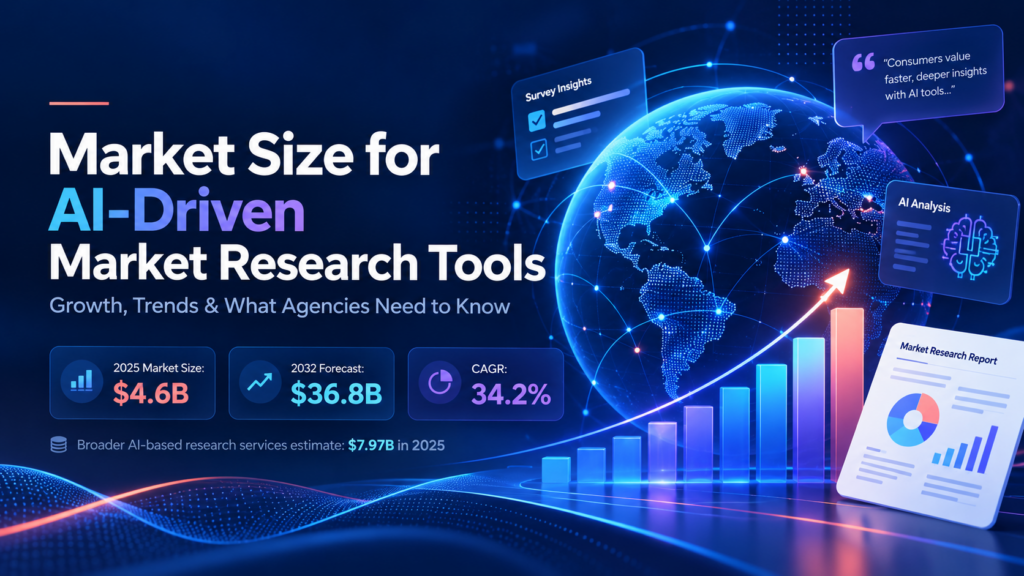
Market Size for AI-Driven Market Research Tools: Growth, Trends and What Agencies Need to Know

AI has moved from experiment to everyday practice in market research. Researchers now use it to draft surveys, analyse qualitative data, code open-ended responses, review interview transcripts, structure reports and automate repetitive research tasks. Demand for AI tools for market…
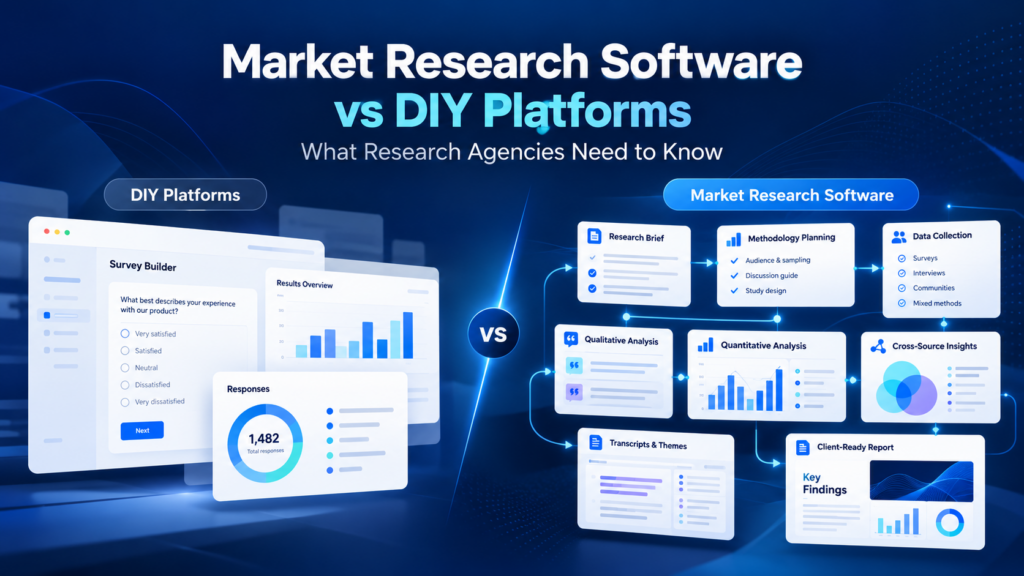
Market Research Software vs DIY Research Platforms: What Research Agencies Need to Know
Launching a survey has never been easier. A marketing manager can write a questionnaire, buy panel sample and watch responses arrive on a dashboard before lunch. That is genuinely useful, and it has changed what clients can do for themselves….
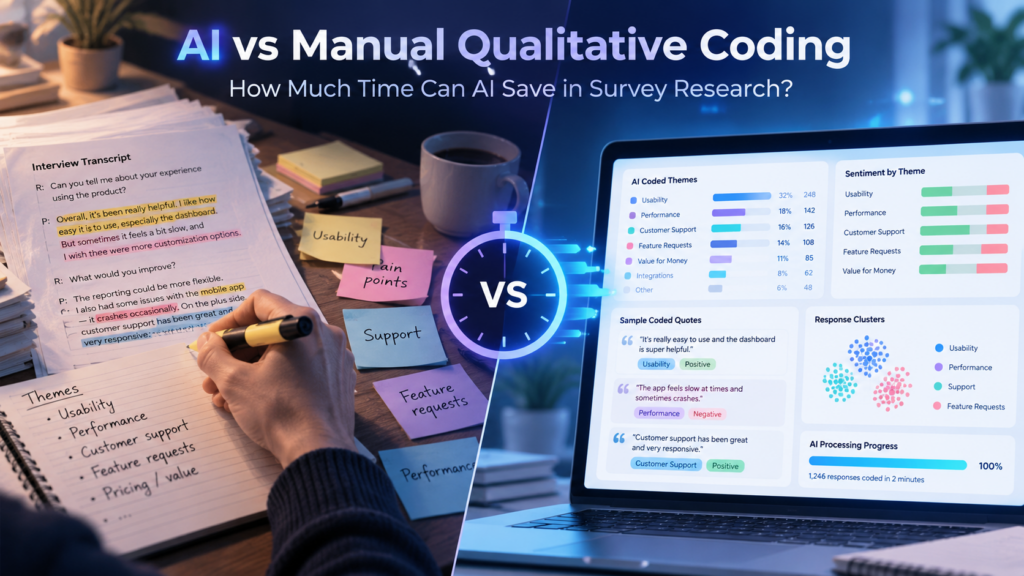
AI vs Manual Qualitative Coding: How Much Time Can AI Save in Survey Research?
Many research projects move quickly through fieldwork and then slow down. Hundreds of open-ended responses arrive, or a stack of interview transcripts, and someone has to make sense of them. Traditionally, qualitative coding means researchers read every response, identify themes,…