
AI Automation
AI vs Manual Qualitative Coding: How Much Time Can AI Save in Survey Research?
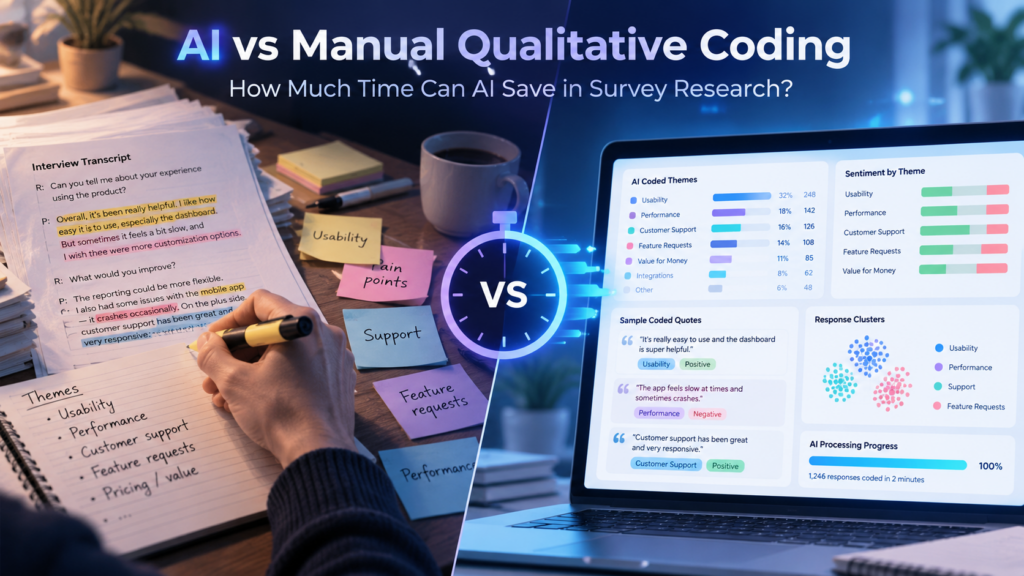

Many research projects move quickly through fieldwork and then slow down. Hundreds of open-ended responses arrive, or a stack of interview transcripts, and someone has to make sense of them.
Traditionally, qualitative coding means researchers read every response, identify themes, build a code frame, tag responses, compare patterns and turn what they find into insight. AI qualitative data analysis can take on a large share of that production work. The real question is where AI genuinely saves time, and where researcher judgement still matters.
This guide compares AI vs manual qualitative coding, examines where AI is most likely to save time, and covers a related question agencies often ask: how long should survey design take?
What Is Qualitative Coding?
Qualitative coding means assigning labels or categories to unstructured information, such as:
- Interview transcripts
- Open-ended survey responses
- Focus group transcripts
- Customer feedback
- Diary study responses
For example, the comment “The checkout process takes too long” might be coded as Usability / Checkout experience.
Once responses are coded, researchers can count how often themes appear, compare them across groups and spot patterns. Coding is the bridge between raw words and structured evidence.
How Manual Qualitative Coding Works
The traditional workflow runs roughly like this:
- Read the raw responses or transcripts
- Identify recurring themes
- Develop a code frame
- Apply codes consistently
- Review and refine categories
- Compare themes across respondents
- Interpret what those patterns actually mean
Benefits of Manual Coding
Manual coding gives researchers:
- Close familiarity with the responses
- The ability to understand context
- Sensitivity to unusual comments
- Full researcher control
- A strong understanding of nuance
Main Limitation
Time and scale. As the dataset grows, reading every response properly becomes a serious drain on senior researcher time.
Under tight deadlines, research teams may have to prioritise or sample material, which can reduce coverage. Manual coding can also vary between researchers unless the team uses a clear code frame, calibration and review process.
How AI Qualitative Coding Works
An AI qualitative data analysis tool can help with:
- Reading large volumes of text
- Identifying repeated themes
- Suggesting categories
- Assigning first-pass codes
- Detecting sentiment
- Grouping similar responses
- Summarising themes
The biggest advantage is coverage. AI tools can process every transcript, open-ended response and prior wave in a dataset, applying the same first-pass framework across the material. Some tools can also analyse different data types together, helping researchers connect themes in qualitative material with patterns in survey data.
One important distinction: AI output should be treated as a first pass, not as the final research conclusion. The researcher still needs to review theme definitions, unusual responses, context, contradictions and the final interpretation.
How the tool is built also matters. A generic AI assistant, especially when transcripts are analysed in separate batches, may produce inconsistent theme structures unless the prompt, context and code frame are carefully controlled. Ask the same question twice and you can get two different sets of themes. Source traceability can also be limited if the tool does not preserve links back to the underlying responses. Research-specific tools can address these issues by maintaining project context, supporting a consistent coding framework and linking conclusions back to source evidence, so there is a golden thread from the brief to every finding.
Beyond Coding: Where Advanced Systems Help with the Analysis Itself
Coding and assimilation are where most AI tools stop. The more advanced research-specific systems go further. Insightology’s Multi-Modal Analyser, for example, is trained to work through the material the way an experienced qualitative researcher would: asking what a response actually means, why people are saying it, what emotional needs and tensions sit underneath it, where respondents contradict themselves or each other, and where a thread that could become a breakthrough insight is beginning to show.
That is not a replacement for the human analyst. It is a different kind of first pass: not just themes and counts, but the building blocks of great analysis — interpretation, an understanding of meaning, the why behind the what, the emotional drivers and tensions, and the early signs of something genuinely new. Each of them is surfaced with a trail back to the source responses, so the team can check it.
The human team then does what only it can do. It weighs those interpretations against the brief and the client’s context, decides which of them matter, discards the ones that do not survive scrutiny and builds the final story. The difference is that the researchers are now choosing from the complete set of interpretations, meanings and candidate insights across every transcript and open-end, rather than from the handful someone had time to notice. The leap to insight is still human. What it leaps from has changed.
AI vs Manual Qualitative Coding
Here is how the two approaches compare.
| Area | Manual coding | AI-assisted coding |
| Speed | Slower | Faster first pass |
| Large datasets | Resource-heavy | Easier to scale |
| Researcher control | Very high | High, with review |
| Consistency | Can vary between coders | Can improve consistency with a defined framework |
| Context and nuance | Strong | Requires human review for nuance |
| Sensitive research | Strong human oversight | Needs careful human oversight |
| Best use | Small, sensitive or highly interpretive studies | Larger datasets and repetitive first-pass coding |
Neither approach is simply better. The right choice depends on the study, the dataset size, the sensitivity of the topic, the timeline and how much interpretation is required.
How Much Time Can AI Save in Qualitative Analysis?
AI mainly reduces the mechanical part of analysis:
- Transcription
- First-pass coding
- Theme grouping
- Initial summarisation
A substantial share of research time can go into preparing, cleaning and organising data. Forsta cites research suggesting that researchers spend around 80% of their time on data preparation and only 20% on analysis and insight. Insightology reports that agencies using its specialist AI platform recover up to 50% of project time across proposals, fieldwork materials and analysis.
AI does not remove researcher work entirely. Researchers still need time for:
- Validation
- Interpretation
- Checking evidence
- Identifying exceptions
- Connecting findings to the research question
- Preparing client recommendations
Good AI survey analysis can shorten transcription and first-pass coding substantially. Advanced research-specific systems also shorten the interpretive stage, by surfacing meanings, tensions and candidate insights for the team to test, although cross-case synthesis and the final client story still need senior researcher time.
A caution on measuring the saving: a fast first draft does not create a real efficiency gain if senior researchers then spend the saved time rewriting it. Output that needs rewriting does not remove hours; it moves them from drafting to polishing. When comparing survey analysis software, count the review and correction time needed to make outputs client-ready, not just the time to first draft.
How Long Should Survey Design Take?
There is no single correct amount of time for survey design. It depends on:
- Research objectives
- Questionnaire length
- Audience complexity
- Number of markets
- Routing and logic
- Screening requirements
- Stakeholder review
- Whether questions need testing
A short customer feedback survey might take hours. A thirty-minute questionnaire for a needs-based segmentation, across several markets with complex routing, can take days of senior time and several rounds of client review.
Faster Survey Design Does Not Mean Rushed Survey Design
AI survey tools can help researchers:
- Draft questions
- Identify repetitive wording
- Suggest answer options
- Improve questionnaire structure
- Create initial screeners
- Review survey logic
The gains can be large. Insightology reports that Box Clever reduced survey design from two days to about one hour using its specialist research platform. AI can also make iteration faster because revisions can be applied quickly once the methodology and objectives are agreed.
But researchers should still check:
- Whether each question supports the objective
- Leading or biased wording
- Answer-option quality
- Respondent burden
- Survey flow
- Routing
- Methodology
These issues can quietly undermine a study. Consider a needs battery for a segmentation. A statement such as “I want to manage my condition well” sounds sensible, but if almost everyone agrees, it may do little to distinguish between respondents. On a five-point agreement scale, responses may cluster at the top end, reducing discrimination. The fix is to write statements in tension, trade-offs that somebody would genuinely reject, and to choose a scale that forces discrimination. Nothing necessarily looks wrong on the page; the weakness may only become clear during analysis. AI can draft quickly, but researchers still need to recognise whether a question will produce useful data.
Where AI Saves Time Across the Survey Research Workflow
Coding is only one stage. AI can also support an end-to-end research workflow when each stage is connected to the research objectives and reviewed by researchers.
1. Research Brief
AI can organise the brief into business and research objectives, summarise background material and flag missing information before design begins.
2. Survey Design
AI can produce first drafts of questionnaires and screeners that follow the agreed methodology, and iterate on them in minutes.
3. Fieldwork
Automation can help with repetitive monitoring tasks, scheduling and live transcription.
4. Analysis
AI survey analysis can bring quantitative data and open-ended responses into a joined-up analysis workflow, helping researchers compare evidence across sources.
5. Qualitative Coding
AI can provide first-pass themes and code suggestions, and advanced systems add a first layer of interpretation — meaning, motivation and tension — for researchers to review, refine and build on.
6. Reporting
AI can help structure summaries and build the deck. Researchers decide which findings actually matter and what the client should hear first.
When Should You Use Manual Coding?
Manual coding may make more sense when:
- The dataset is small
- The topic is highly sensitive
- Language is subtle or culturally specific
- The research is exploratory
- Understanding individual responses deeply is important
- The methodology requires close researcher involvement
When Does AI-Assisted Coding Make More Sense?
AI-assisted analysis becomes useful when:
- There are hundreds or thousands of open-ended responses
- Multiple interviews need to be analysed quickly
- Repetitive coding is taking too much researcher time
- The agency runs recurring studies
- Consistent first-pass classification is useful
- Project turnaround is tight
Why a Hybrid Approach Often Works Best
For most agency projects, the strongest workflow combines both:
AI handles the repetitive first pass; the researcher reviews and refines it; the researcher interprets the evidence; and the researcher builds the client story.
This gives the agency speed without giving up professional judgement. Used this way, AI-assisted qualitative analysis becomes a co-pilot for the researcher rather than a shortcut around them: it makes sure every interpretation, meaning and possible insight is on the table, and the researchers decide which of them are true, which matter and what the client should do about them.
The reason the researcher stays in the lead is not just caution. AI systems can overemphasise recurring patterns, while researchers can recognise the strategic importance of a rare but revealing comment. Frequency is useful evidence, but it is not the same as significance. A single response may matter because of its context, contradiction or implication, and deciding that requires research judgement.
The key idea: use AI for scale, coverage and the first layers of interpretation. Use researchers for context, judgement and the final meaning.
What Research Agencies Should Look for in AI Analysis Tools
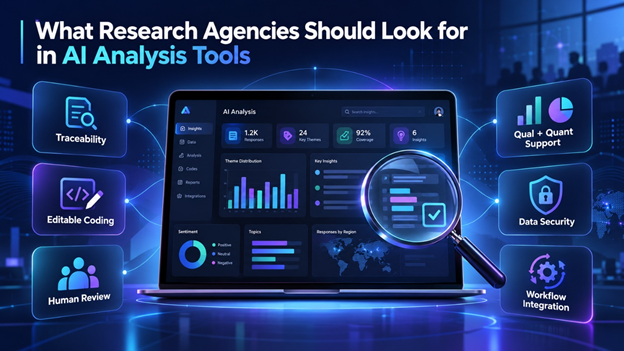
Not every tool that offers AI for data analysis is suited to professional research. Look for:
- Traceability. Can researchers see the source responses behind every theme?
- Editable coding. Can AI-generated codes be changed, merged or refined?
- Human review. Can researchers validate outputs before they are used?
- Qual and quant support. Can the tool work across different research methods and data types?
- Depth of analysis. Does it stop at themes and counts, or does it surface meaning, motivation, tension and candidate insights, with a trail back to the source, for researchers to test?
- Data security. How is client and respondent data handled? Is client data used to train models, and what contractual protections apply? The right answer is never, and it belongs in the contract rather than the sales pitch.
- Workflow integration. Does it work with the agency’s existing market research software?
- Useful outputs. Does it support real research decisions, rather than simply generating summaries?
AI Should Reduce Grunt Work, Not Research Thinking
Speed alone should not be the goal. The point of removing mechanical work is to give researchers more time for:
- Methodology
- Interpretation
- Challenging assumptions
- Understanding context
- Finding the story behind the data
- Preparing stronger recommendations
Researchers create the most value when they are applying methodology, interpretation and judgement, yet substantial time can be absorbed by formatting, processing and other repetitive tasks. AI should reduce that workload, not replace the expertise behind the research.
Conclusion
Manual qualitative coding gives researchers close contact with the data, but it becomes slower as datasets grow. AI qualitative data analysis and AI survey analysis can accelerate first-pass coding and theme identification, especially on larger datasets.
Good survey design, validation, interpretation and client recommendations still require human research judgement. Advanced research-specific systems can go beyond coding and surface meaning, motivation, tension and the beginnings of insight for the team to test, but deciding which of those are real, which matter and what the client should do about them remains human work. The best results come from a hybrid workflow where each side does what it does best: the researcher leads, and the AI supports.
See how Insightology helps market research agencies reduce repetitive work across survey design, qualitative analysis and the wider research workflow while keeping researchers in control.
FAQs
What is AI qualitative data analysis?
AI qualitative data analysis uses artificial intelligence to process unstructured data such as interview transcripts, open-ended survey responses and focus group notes. It can suggest themes, apply first-pass codes, detect sentiment and summarise findings. More advanced research-specific systems also surface interpretation: what responses mean, why people say them, the emotional needs and tensions underneath, and the early signs of a breakthrough insight. Researchers review, test and interpret those results and build the final story.
Is AI qualitative coding better than manual coding?
Neither is universally better. AI can be faster and more consistent for first-pass coding on large datasets. Manual coding offers deeper familiarity and nuance on small, sensitive or exploratory studies. Many agencies get the best results from a hybrid approach, with AI doing the first pass and researchers reviewing, refining and interpreting it.
How long does qualitative coding take?
It depends on the volume and complexity of the data. Manually coding several hundred open-ended responses or a set of in-depth interviews can take hours or days of researcher time. AI can produce a first-pass code frame much faster, though researchers still need time to review, refine and interpret it.
How long should survey design take?
There is no fixed answer. It depends on objectives, questionnaire length, audience complexity, number of markets, routing and stakeholder review. AI survey tools can cut drafting time sharply, but researchers should still check every question against the objectives, the scale choices and the survey flow.
Can AI analyse open-ended survey responses?
Yes. AI tools can read and code large volumes of open-ended responses quickly, group similar answers and identify themes. Researchers should check that themes are traceable to the underlying responses and review unusual or contradictory answers before drawing conclusions.
Only pay
when you win
Get the AI market research platform your team needs. For Free.
Proposals stay free, so you don't pay for the groundwork. You'll only pay for completed projects.
Related articles
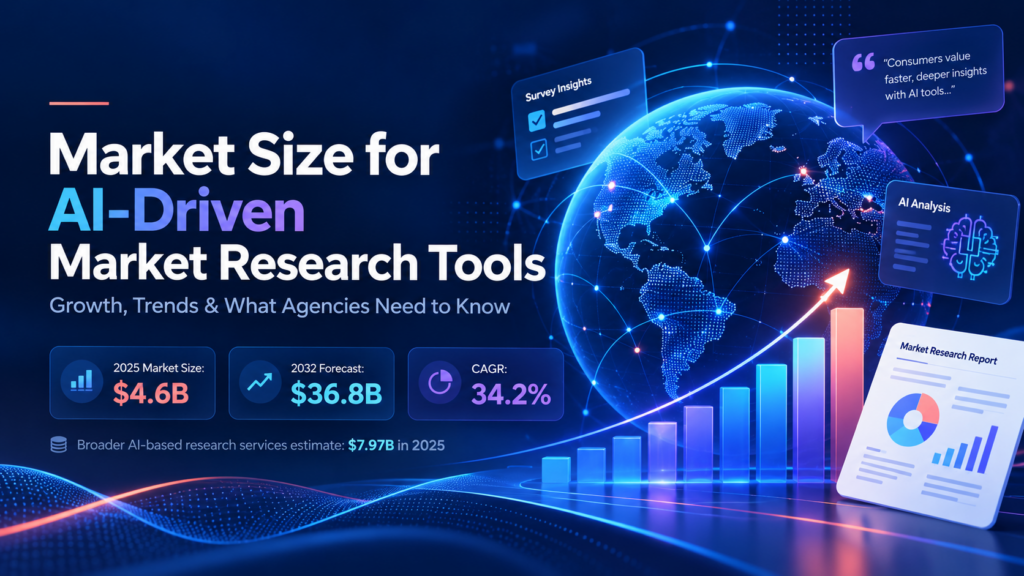
Market Size for AI-Driven Market Research Tools: Growth, Trends and What Agencies Need to Know

AI has moved from experiment to everyday practice in market research. Researchers now use it to draft surveys, analyse qualitative data, code open-ended responses, review interview transcripts, structure reports and automate repetitive research tasks. Demand for AI tools for market…
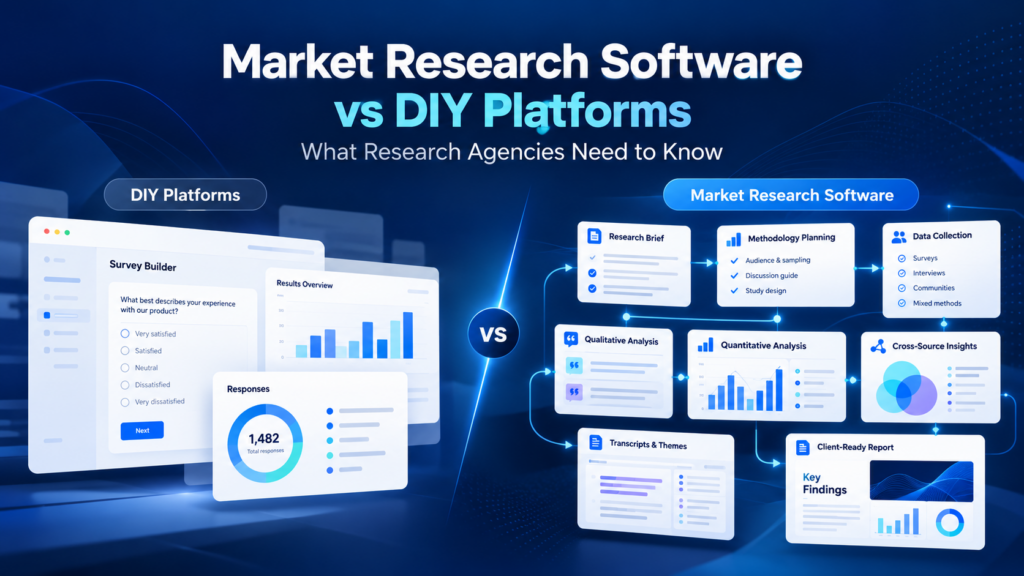
Market Research Software vs DIY Research Platforms: What Research Agencies Need to Know
Launching a survey has never been easier. A marketing manager can write a questionnaire, buy panel sample and watch responses arrive on a dashboard before lunch. That is genuinely useful, and it has changed what clients can do for themselves….

Will AI Replace Market Research Agencies? An Honest Answer
No — but it will replace agencies that treat it as a threat rather than a tool. AI is already replacing the execution layer of research: coding, cleaning, transcribing, formatting. What it cannot replace is judgment. The agencies that thrive…