
AI Automation
Market Size for AI-Driven Market Research Tools: Growth, Trends and What Agencies Need to Know

AI has moved from experiment to everyday practice in market research. Researchers now use it to draft surveys, analyse qualitative data, code open-ended responses, review interview transcripts, structure reports and automate repetitive research tasks.
Demand for AI tools for market research is rising, and investment is following. For research agencies, understanding the market size matters for a practical reason: it shows where clients, competitors and software vendors are putting their money, and which parts of the research workflow are changing fastest.
This article explains what counts as an AI market research tool, what the current estimates say, why they differ, and what the growth means for research agencies.
What Counts as an AI-Driven Market Research Tool?
Before looking at market size, it helps to define the category, because market research AI tools cover many different parts of the research lifecycle. Examples include:
- AI survey design tools
- Survey and data analysis
- Qualitative coding
- AI-moderated interviews
- Consumer intelligence
- Sentiment analysis
- Competitive intelligence
- Automated reporting
- End-to-end research workflow platforms
These are very different products. A sentiment-analysis dashboard and a platform that runs a strategic project from brief to debrief both use AI, but they solve different problems for different buyers.
It also helps to separate three kinds of technology. A generic AI assistant is a general-purpose model, trained on public data, used through a chat interface. A skills layer adds the agency’s own prompts, templates, custom agents and instructions on top of that same engine. A specialist AI platform is software purpose-built for a profession, with domain-specific methods and workflows designed into the product itself rather than supplied by whoever happens to be typing. Market-size reports rarely draw these lines, which is one reason their numbers vary.
How Big Is the Market for AI-Driven Market Research Tools?
Depending on how the category is defined, current estimates vary. There is no single, universally accepted figure, because analysts include different products and services in their scope. Two recent forecasts illustrate the range.
| Source | Market covered | 2025 value | Forecast value |
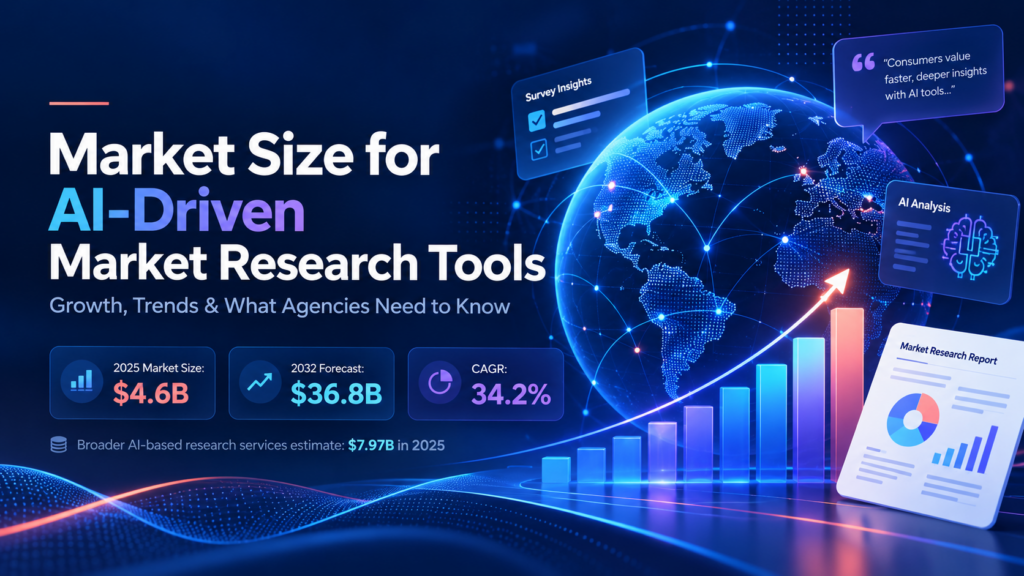
| Stratistics MRC | AI in market research | $4.6B (2025) | $36.8B by 2032 |
| Future Market Insights | AI-based research services | $7.97B (2025) | $35.42B by 2035 |
Stratistics MRC forecasts a 34.2% compound annual growth rate (CAGR) from 2025 to 2032 for its definition of the market. Future Market Insights forecasts a 16.1% CAGR from 2025 to 2035 for its broader AI-based research-services category.
Why the difference? The first estimate focuses on AI software and services applied to market research. The second covers a wider set of AI-enabled research services over a longer period. A narrower category growing from a smaller base can post a faster growth rate while ending at a similar total.
For context, ESOMAR’s Global Market Research 2025 report puts the wider insights industry at about US$153 billion in 2024. Research software accounted for roughly US$62 billion and grew 11.5% in 2024, compared with 4.8% growth in the established market research sector.
The sensible reading is not a single number. It is that every credible estimate points the same way: rapid growth, from a base that is still small relative to the wider industry.
Why Is the AI Market Research Market Growing?
Several forces are pushing demand in the same direction.
Research Teams Need Faster Turnaround
Clients increasingly expect insight in days rather than weeks. Automation can reduce manual work in survey development, coding, analysis and reporting. Insightology reports that agencies using its specialist AI platform recover up to 50% of project time across proposals, fieldwork materials and analysis; Box Clever, for example, cut survey design from two days to about one hour.
Researchers Are Working with More Unstructured Data
Interviews, open-ended survey answers, video, transcripts, social listening and client documents create enormous volumes of qualitative material. Gartner says 70% to 90% of enterprise data is unstructured, highlighting the scale of the material organisations increasingly need to govern and analyse.
AI can process large volumes of this material faster than a human team, but scale does not remove the need for researcher review. Used well, it can analyse every transcript, open-ended response and prior wave consistently, while researchers validate the patterns and decide what matters.
Generative AI Has Expanded What Research Software Can Do
Traditional analytics tools crunch numbers. Newer AI market research tools can also support research design, summarisation, questionnaire development, qualitative analysis and reporting. In practice, AI makes it more feasible to analyse mixed data types — numbers, words, images and recordings — in a more joined-up workflow.
Agencies Are Under Pressure to Improve Efficiency
Speed, capacity, project margins and client expectations are all creating interest in market research automation. Insightology estimates that 50 to 70% of billable hours on a typical strategic project can go on production work: drafting proposals, writing surveys and guides, processing data and building decks. That is exactly the kind of work AI can compress, increasing the pressure on agencies to improve efficiency without sacrificing quality.
Which Types of AI Market Research Tools Are Growing?
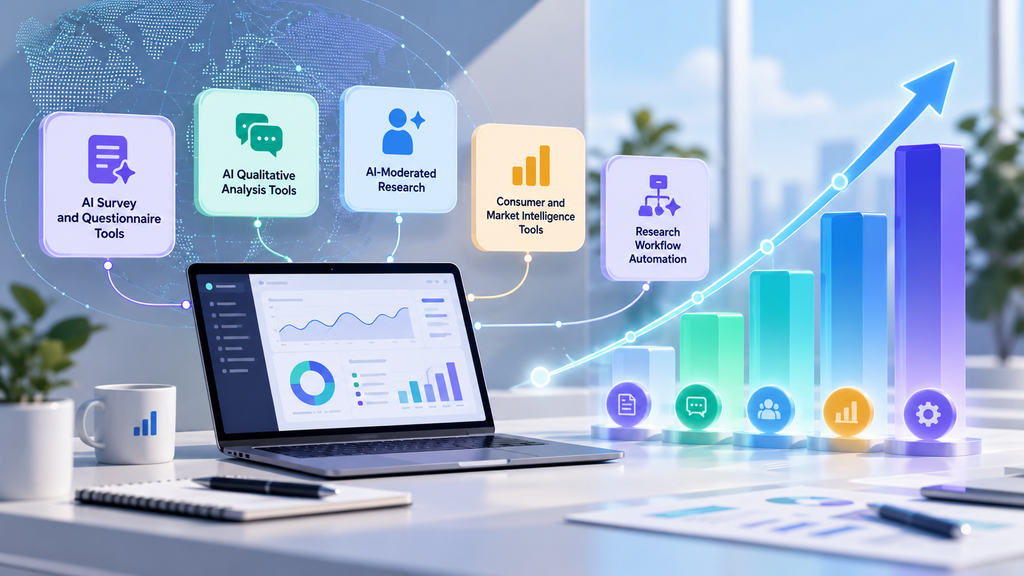
Rather than individual brands, it is more useful to look at the main categories.
1. AI Survey and Questionnaire Tools
Tools that support survey creation, scripting and analysis, from first-draft questions to logic checks.
2. AI Qualitative Analysis Tools
Platforms that help analyse interviews, transcripts, open-ended responses and themes, often providing a first-pass code frame for researchers to refine.
3. AI-Moderated Research
Tools that conduct or support research conversations at scale. These are becoming useful for structured interviews, although high-quality depth moderation still depends on human judgement, rapport and the ability to respond to nuance in real time.
4. Consumer and Market Intelligence Tools
Platforms that identify trends, audiences, competitors and market signals from large external datasets.
5. Research Workflow Automation
Tools that connect several stages of a research project rather than solving one task. These AI market research platforms hold the brief, methodology, instruments, analysis and reporting in one place, so each stage feeds the next and every output can be traced back along a golden thread from brief to debrief.
Across all five, platforms are increasingly defined by where they operate in the research lifecycle, not simply by whether they use AI. “We use AI” is now about as informative as “we use software”.
What Does This Market Growth Mean for Research Agencies?
The headline numbers matter less to agencies than what sits behind them.
AI Is Becoming a Client Expectation
Clients know what AI can do, and many expect faster, leaner delivery as a result. The Marketing Research Institute International’s 2026 survey of 498 market research and insights professionals found that approximately half use AI regularly, while only about one in ten say it is fully embedded in their standard workflows. Adoption is growing, but deep integration is still limited.
DIY Platforms Create More Competition
Some DIY research platforms allow client-side insight and marketing teams to run simple studies themselves. Concept screens, basic trackers and quick polls will keep moving in-house, and there is little an agency can do to stop that.
That does not make agencies unnecessary. What stays with agencies, and grows in value, is complex, high-stakes work with multiple stakeholders, where method, independence and judgement are what the client is paying for.
Agencies Can Use AI to Improve Their Own Workflow
The opportunity is to reduce repetitive production work while keeping researchers in charge of methodology and interpretation. Freed hours can go into more proposals, more projects or deeper thinking on each one.
There is a trap here. Generic AI output can look plausible while still needing substantial senior review before it is client-ready. Insightology calls this the polishing tax: senior people spending their afternoons lifting almost-right work to a professional standard. If teams save time on drafting but spend it checking context, correcting methodology or rewriting outputs, the gain is smaller than it first appears. The tool you choose determines whether time is genuinely saved or simply moved into rework.
Human Research Expertise Still Matters
AI can process information quickly, but decisions about research design, methodology, context, interpretation and client recommendations still need professional judgement. Generative models are good at identifying likely patterns; research value often comes from deciding whether an unexpected finding is real, meaningful and worth acting on. Plausible is not the same as warranted: clients pay for findings where the method, the data and the trail back to real respondents can all be shown.
What Should Agencies Look for in Market Research AI Tools?
Use this practical checklist when evaluating options.
- Research-specific capability. Is it built for research, or is it a generic AI tool with a research label?
- Workflow coverage. Does it help with one task or several stages of the project?
- Qual and quant support. Does it match the types of research the agency actually delivers?
- Human control. Can researchers review, edit and approve outputs, and trace them back to source data?
- Data security. How is sensitive client and respondent data handled? Ask what data is retained, whether client data is used for model training, what contractual protections apply, and whether certifications such as SOC 2 or ISO 27001 are required for your procurement process.
- Integration. Does it work with existing market research tools, such as survey platforms, panels and reporting software?
- Business value. Does it save meaningful time or increase project capacity once review time is counted?
Where Is the Market Heading Next?
The market appears to be moving toward AI built directly into research workflows, rather than bolted on at the edges. Likely developments include:
- Fewer disconnected point tools, and more connected platforms
- Stronger integration between qual and quant
- More automated first-pass analysis
- Greater emphasis on data security in client procurement
- Increased human review and validation of AI outputs
- AI moving from experimentation into everyday research operations
Legal AI offers a useful parallel. Specialist platforms such as Harvey have scaled to more than 100,000 lawyers, while foundation-model providers are also moving into domain-specific legal products. OpenAI launched Astra for Law in September 2026, designed to work alongside specialist legal tools rather than simply replace them. The broader lesson for research is that more capable foundation models do not remove the need for specialist workflow layers; they can make those layers more useful.
What This Means for Research Agencies
The market is expanding quickly, but the important question for agencies is not simply “Should we use AI?” It is “Where can AI genuinely improve our research workflow without weakening research quality?”
Agencies that choose market research AI tools selectively and use them responsibly may be able to:
- Reduce repetitive work
- Improve turnaround
- Increase project capacity
- Spend more researcher time on interpretation and strategic thinking
The right AI tools for market research hand time back to researchers. The wrong ones create a new editing job on top of the thinking job.
Conclusion
The market size for AI-driven market research tools shows strong growth, even though published estimates differ depending on what each analyst includes in the category. Every credible forecast points in the same direction.
For agencies, the more important point is that AI is becoming a standard part of professional research workflows. The advantage will go to agencies that use it to remove production work while keeping researchers firmly in control of the thinking.
Explore how Insightology helps market research agencies use specialist AI across the research workflow while keeping researchers in the lead.
FAQs
What is the market size for AI-driven market research tools?
Estimates vary by definition. Stratistics MRC values AI in market research at $4.6 billion in 2025, reaching $36.8 billion by 2032. Future Market Insights values AI-based research services at $7.97 billion in 2025, reaching $35.42 billion by 2035.
How fast is AI in market research growing?
Forecasts range from about 16% to 34% a year, depending on how the market is defined. MRII’s 2026 survey found that approximately half of insights professionals use AI regularly, while only about one in ten say it is fully embedded in standard workflows.
What are market research AI tools?
Market research AI tools use artificial intelligence to support research tasks such as survey design, qualitative coding, interview analysis, sentiment analysis, market intelligence and reporting. Some handle a single task, while others connect the whole research workflow from brief to debrief.
What is the best AI tool for market research?
It depends on the work. For quick, low-stakes tasks, a generic AI assistant may be enough. For strategic research that clients audit and act on, agencies typically need research-specific workflow support, human review, source traceability and strong data-governance controls.
Only pay
when you win
Get the AI market research platform your team needs. For Free.
Proposals stay free, so you don't pay for the groundwork. You'll only pay for completed projects.
Related articles

The Best AI Market Research Tool in 2026: What to Look For (and the Twelve Questions to Ask)

Every vendor in this category claims to be the best AI market research tool, and most of the claims use the same vocabulary: agentic, end-to-end, research-grade, secure. The words have stopped carrying information. “We use AI” is now about as…

The Apprenticeship Crisis: Training Junior Researchers When AI Does the Production Work
Of all the questions agency leaders ask me about AI, the one they are most reluctant to raise out loud is this one: if the work that used to train juniors has gone, where does the next generation of great…

Market Research Automation Software in 2026: What to Automate, and What to Keep Human
The distinction that matters in 2026 is a simple one. Automation handles execution; research handles understanding. Put in the terms agencies now use, that is the split between production work and thinking, and it decides what market research automation software…