
AI Automation
How Market Research Agencies Can Use AI Across the Whole Project — Brief to Debrief


The biggest AI mistake agencies make is bolting point tools onto a broken pipeline. Separate tools for scripting, fielding and analysis that don’t talk to each other just relocate the rework. The real gains come from an end-to-end AI market research workflow, where every stage feeds the next. Here’s what that looks like across a project’s life.
Where do projects actually go wrong? The brief.
Vague briefs are the primary cause of downstream failure, and it’s the stage agencies neglect most. A brief decoder doesn’t summarise the client’s request — it unpacks it, flags the missing information, and challenges assumptions against the client’s known strategic goals. Ten minutes here saves ten hours of rework later.
Choosing the methodology
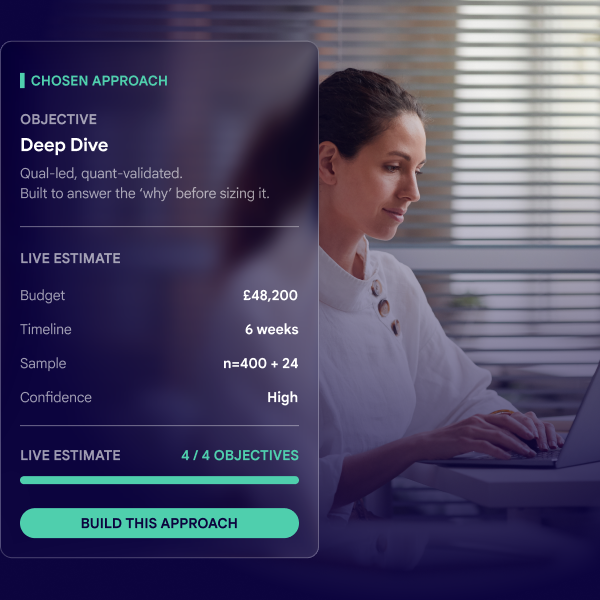
From a decoded brief, a methodology mixer draws on hundreds of research designs — semiotics, behavioural science, complex quant models — and suggests an approach tailored to the actual problem rather than the house template. This is where agencies out-design DIY platforms, which win on speed but routinely fail on instrument quality.
Proposals and materials in minutes, not days
AI research proposals are the most immediate margin win: early drafting, costing and team-sheet assembly automated, so you respond to RFPs with a superior methodology in minutes while competitors are still formatting. The same applies to materials — a discussion guide or survey screener that took days of senior time can be 80% complete in minutes, leaving the researcher to craft the 20% that needs client nuance.
Fieldwork without the panel tax
AI-driven sourcing finds niche participants directly, bypassing expensive third-party panels, while AI avatar interviewers deliver qual at scale — 500 depth interviews in 48 hours at a cost structure once reserved for simple quant. For sensitive topics, respondents are often more honest with an AI interviewer; for exploratory or emotionally complex briefs, human moderators remain king. Knowing the difference is the agency’s craft.
Analysis: stats for words and pictures
The best insights sit at the intersection of survey data, open-ends, video and social mentions — exactly where human analysts struggle and confirmation bias creeps in. Multi-modal analysis reads, hears and counts thousands of files simultaneously, linking a chart data point to a verbatim in a group to an emotional cue in a video. Weeks of manual coding become hours, and descriptive summaries become the “why”.
The result
This is the model behind Insightology, the first AI workflow built specifically for market research agencies: one backbone from brief to debrief. Agencies report 50–60% of project time back; Box Clever cut survey design from two days to one hour. Speed no longer implies shallow thinking, and depth no longer needs a six-week lead time.
Only pay
when you win
Get the AI market research platform your team needs. For Free.
Proposals stay free, so you don't pay for the groundwork. You'll only pay for completed projects.
Related articles
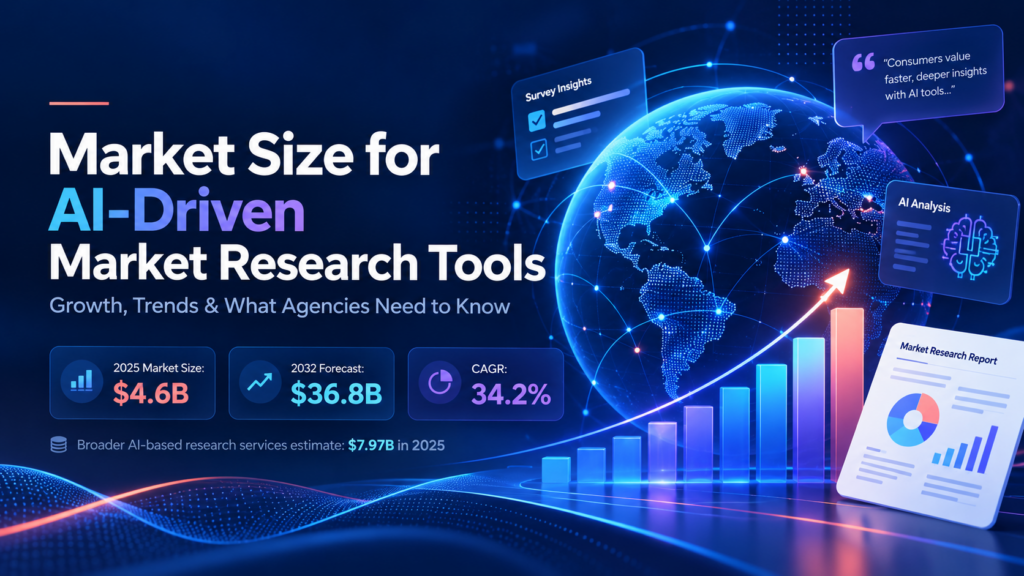
Market Size for AI-Driven Market Research Tools: Growth, Trends and What Agencies Need to Know

AI has moved from experiment to everyday practice in market research. Researchers now use it to draft surveys, analyse qualitative data, code open-ended responses, review interview transcripts, structure reports and automate repetitive research tasks. Demand for AI tools for market…
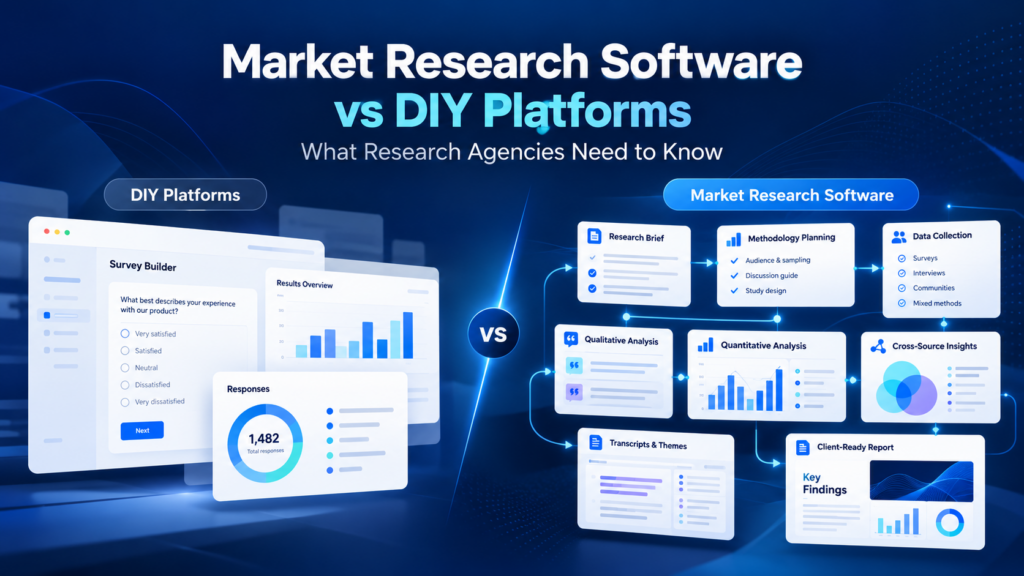
Market Research Software vs DIY Research Platforms: What Research Agencies Need to Know
Launching a survey has never been easier. A marketing manager can write a questionnaire, buy panel sample and watch responses arrive on a dashboard before lunch. That is genuinely useful, and it has changed what clients can do for themselves….
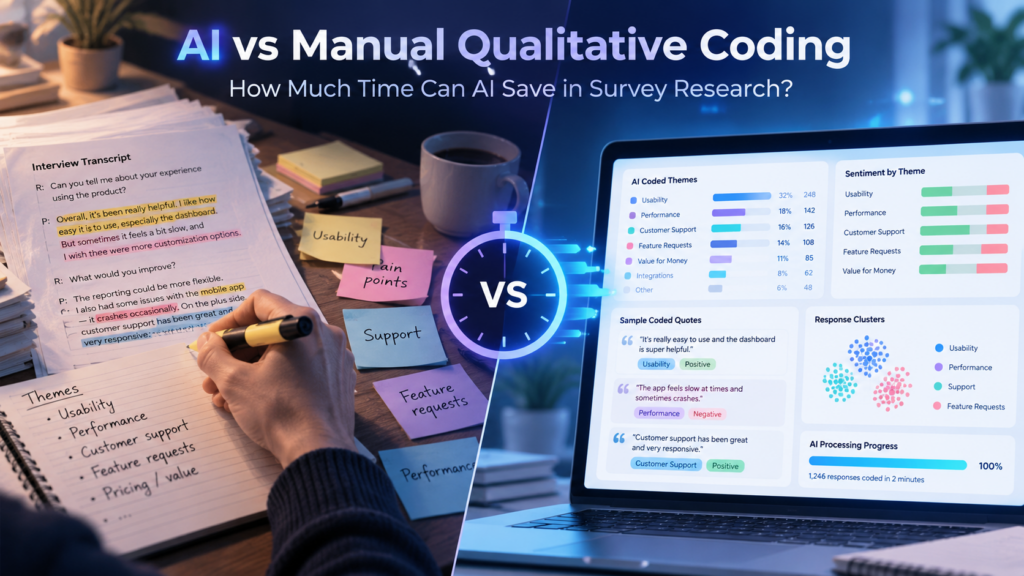
AI vs Manual Qualitative Coding: How Much Time Can AI Save in Survey Research?
Many research projects move quickly through fieldwork and then slow down. Hundreds of open-ended responses arrive, or a stack of interview transcripts, and someone has to make sense of them. Traditionally, qualitative coding means researchers read every response, identify themes,…