
AI Automation
ChatGPT vs Purpose-Built AI for Market Research: Why Generalist LLMs Hit a Quality Ceiling


Generalist AI tools like ChatGPT are brilliant assistants and poor researchers. Trained on the open web, handling every prompt in isolation, and optimised to sound plausible rather than be methodologically sound, they consistently hit a quality ceiling on serious research work. Purpose-built research AI differs on three fundamentals: what it’s trained on, what it remembers, and what it’s allowed to say.
The training data problem
Generalist large language models learn from Reddit, Wikipedia and SEO-optimised blogs — a mile wide and an inch deep. Professional research runs on things that barely exist in public data: industry frameworks, methodological rigour, the domain logic of a discussion guide or a screener. Ask a generalist model to design a quant study and it will produce something that reads like a survey while missing the statistical craft that makes one work.
The context problem
High-stakes research is a cumulative reasoning process. The debrief must honour the brief; the analysis must respect the methodology agreed in the project plan. A generalist chatbot has no memory of any of it — every prompt is an isolated task. Researchers end up paying what we call the polishing tax: hours spent re-pasting context into chat windows and correcting hallucinations that sound confident but are methodologically hollow.
A purpose-built workflow holds the golden thread of project logic end to end. The AI analysing your transcripts already knows the brief, the client’s history and the methodology — because it’s the same system that helped shape all three.
The grounding problem
The third difference is what the AI is permitted to draw on. Research-grade AI operates on grounded accuracy: strictly confined to a closed set of project data — your transcripts, your survey results, your brand history — rather than speculating from the general internet. That shift, from probabilistic guessing to methodological reasoning, is what separates “research-grade” from merely “clever”.
The comparison in brief
- Training data — Generalist: broad, scraped public web. Specialist: deep, industry frameworks and methodology.
- Context — Generalist: single isolated prompts. Specialist: end-to-end project thread.
- Logic — Generalist: predicting the next word. Specialist: research standards and logic.
- Accuracy — Generalist: speculative, hallucination-prone. Specialist: grounded in project data only.
- Interface — Generalist: generic chat. Specialist: agency-first workflow.
What this means in practice
The difference shows up in output quality and in time. Insightology — the first AI workflow built specifically for market research agencies — grounds every stage from brief decoding to debrief in the project’s own data and methods. Box Clever used it to take survey design from two days to about an hour, without the quality trade-off that gives generic AI tools a bad name in agency work.
Generalist AI is a fine place to draft an email. Your client’s brand strategy deserves a tool that knows what a screener is for.
Only pay
when you win
Get the AI market research platform your team needs. For Free.
Proposals stay free, so you don't pay for the groundwork. You'll only pay for completed projects.
Related articles
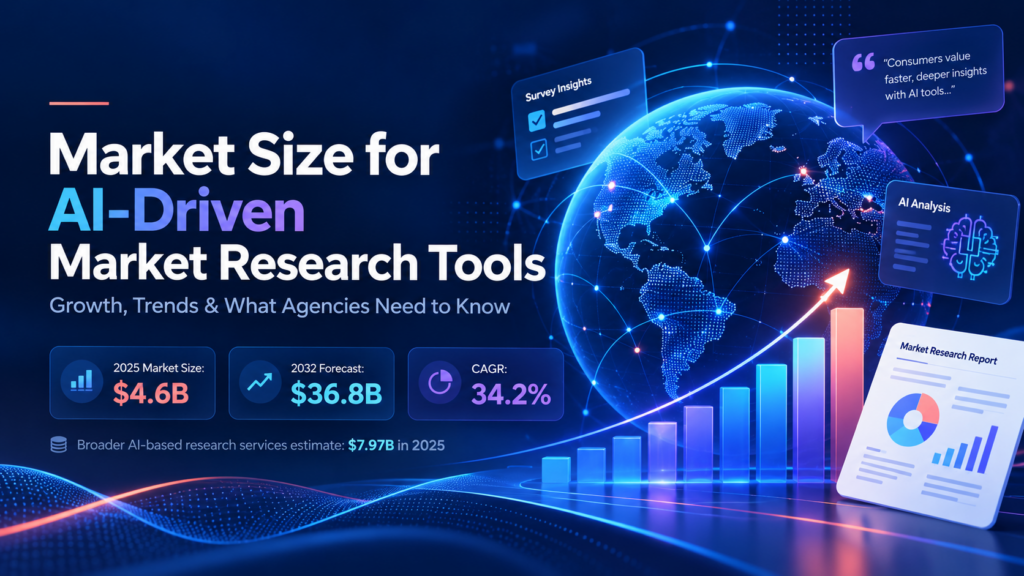
Market Size for AI-Driven Market Research Tools: Growth, Trends and What Agencies Need to Know

AI has moved from experiment to everyday practice in market research. Researchers now use it to draft surveys, analyse qualitative data, code open-ended responses, review interview transcripts, structure reports and automate repetitive research tasks. Demand for AI tools for market…
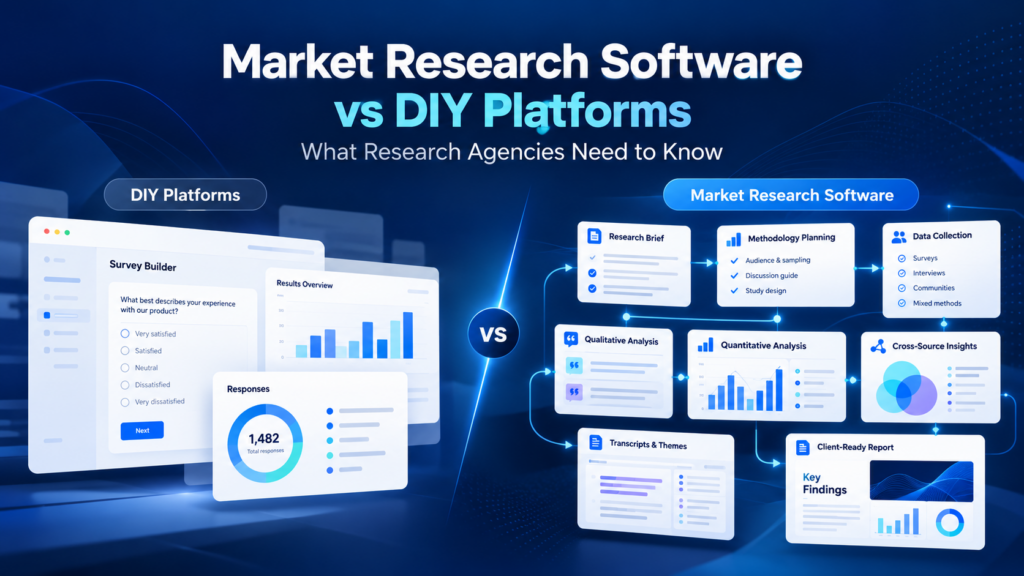
Market Research Software vs DIY Research Platforms: What Research Agencies Need to Know
Launching a survey has never been easier. A marketing manager can write a questionnaire, buy panel sample and watch responses arrive on a dashboard before lunch. That is genuinely useful, and it has changed what clients can do for themselves….
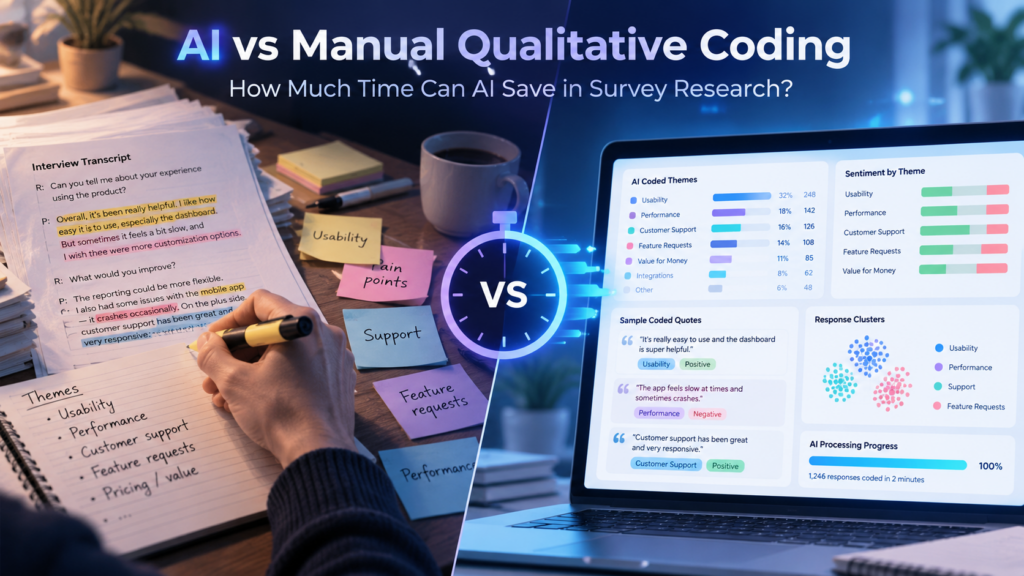
AI vs Manual Qualitative Coding: How Much Time Can AI Save in Survey Research?
Many research projects move quickly through fieldwork and then slow down. Hundreds of open-ended responses arrive, or a stack of interview transcripts, and someone has to make sense of them. Traditionally, qualitative coding means researchers read every response, identify themes,…