
AI Automation
How to Speed Up Survey Design and Scripting Without Sacrificing Quality


How long should survey design take? Traditionally, a proper quantitative instrument — screener, routing, scales, quality checks — takes days of senior researcher time. With AI survey design built on research logic rather than generic text prediction, the honest new answer is about an hour, with the quality bar going up, not down. Here’s how that works and where the human still earns their keep.
Why survey design is slow
Good instruments are craft: screening logic that actually screens, question order that avoids priming, scales that will survive analysis, and the hundred small decisions that separate clean data from expensive noise. That craft has always lived in senior heads and been applied one question at a time — which is why it takes days, and why it’s the first corner cut when timelines squeeze.
What automated survey scripting changes
Purpose-built survey scripting software encodes that craft. Because it’s trained on research methodology rather than the open web, it understands statistical significance, routing logic and question design — so the draft it produces in minutes is 80% of a finished instrument, not a plausible-looking imitation. The researcher’s job shifts to the 20% that needs client context and category nuance: exactly the part that justifies the fee.
This is also the strongest defence against DIY platforms, which win on speed but consistently fail on instrument design. Matching their turnaround while out-designing them removes their entire argument.
The proof: two days to one hour
Box Clever, a UK research agency, used Insightology — the first AI workflow built specifically for market research agencies — to take survey design from two days to about one hour. Not a demo statistic: real client work, brief to scripted instrument. And because survey design sits inside an end-to-end workflow, the instrument inherits the brief and methodology automatically — no re-briefing a disconnected tool, no polishing tax.
Where humans stay in charge
Speed is worthless if the instrument is wrong. Researchers still own the methodological call (is a survey even the right tool?), the category-specific nuance, and the final quality pass — the moments where experience spots what a respondent will misread. The AI removes the transcription of expertise into format; it doesn’t remove the expertise.
What to do with the saved days
The agencies getting this right don’t just pocket the time — they reinvest it: more iterations with the client, a sharper pilot, deeper analysis. Speed and depth stop being a trade-off. That’s the whole point.
Only pay
when you win
Get the AI market research platform your team needs. For Free.
Proposals stay free, so you don't pay for the groundwork. You'll only pay for completed projects.
Related articles
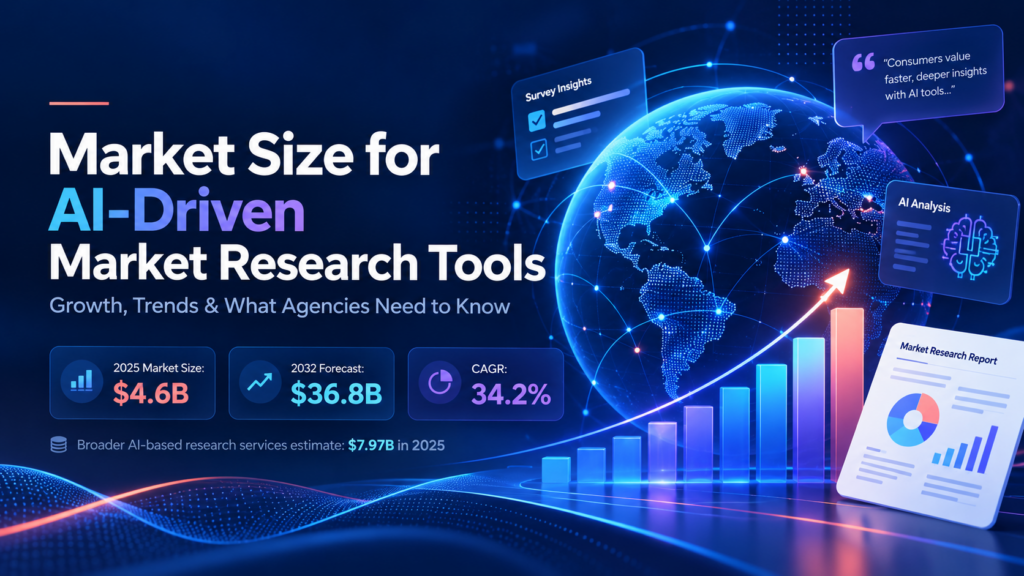
Market Size for AI-Driven Market Research Tools: Growth, Trends and What Agencies Need to Know

AI has moved from experiment to everyday practice in market research. Researchers now use it to draft surveys, analyse qualitative data, code open-ended responses, review interview transcripts, structure reports and automate repetitive research tasks. Demand for AI tools for market…
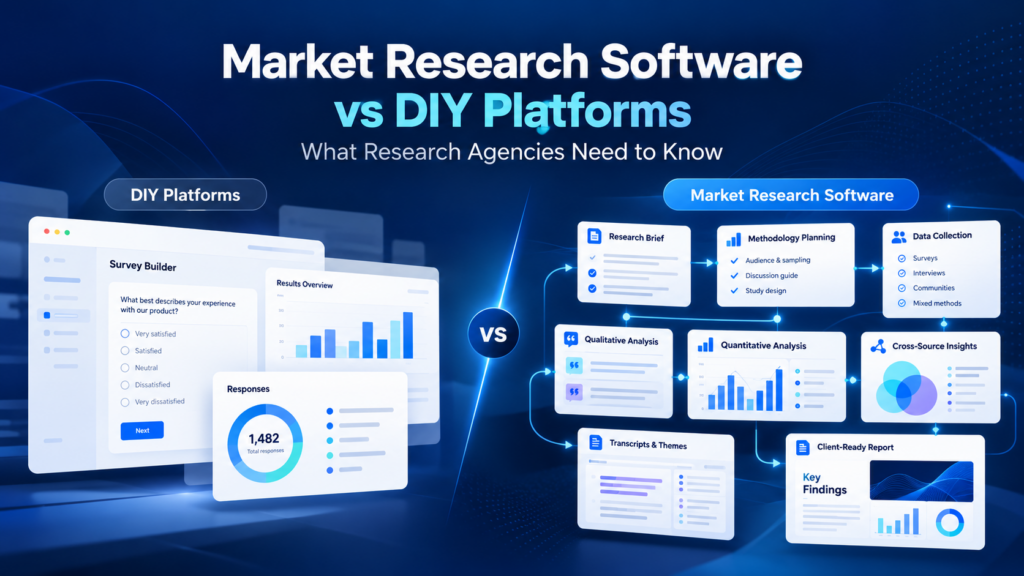
Market Research Software vs DIY Research Platforms: What Research Agencies Need to Know
Launching a survey has never been easier. A marketing manager can write a questionnaire, buy panel sample and watch responses arrive on a dashboard before lunch. That is genuinely useful, and it has changed what clients can do for themselves….
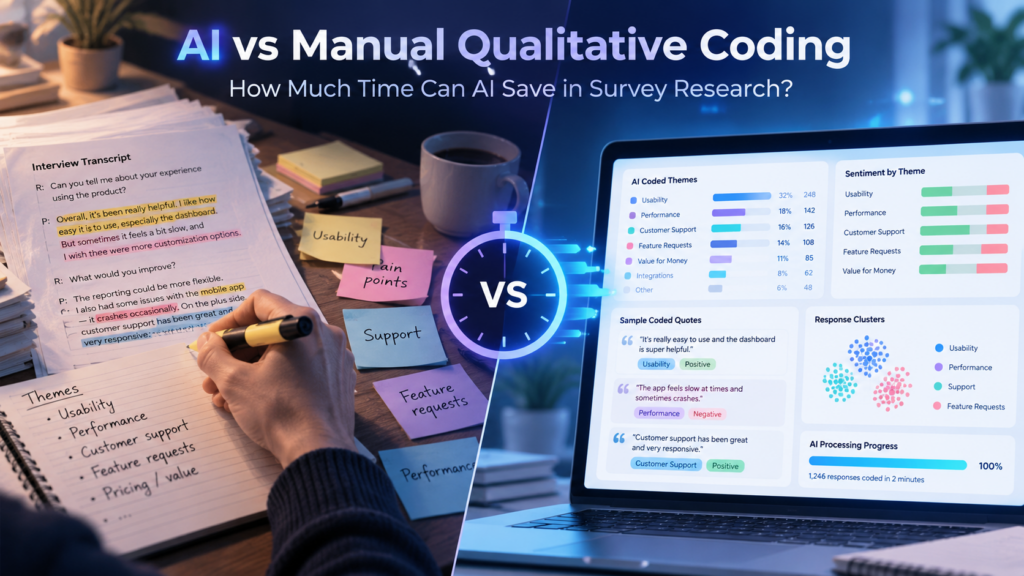
AI vs Manual Qualitative Coding: How Much Time Can AI Save in Survey Research?
Many research projects move quickly through fieldwork and then slow down. Hundreds of open-ended responses arrive, or a stack of interview transcripts, and someone has to make sense of them. Traditionally, qualitative coding means researchers read every response, identify themes,…