
AI Automation
Market Research Software vs DIY Research Platforms: What Research Agencies Need to Know

Launching a survey has never been easier. A marketing manager can write a questionnaire, buy panel sample and watch responses arrive on a dashboard before lunch. That is genuinely useful, and it has changed what clients can do for themselves.
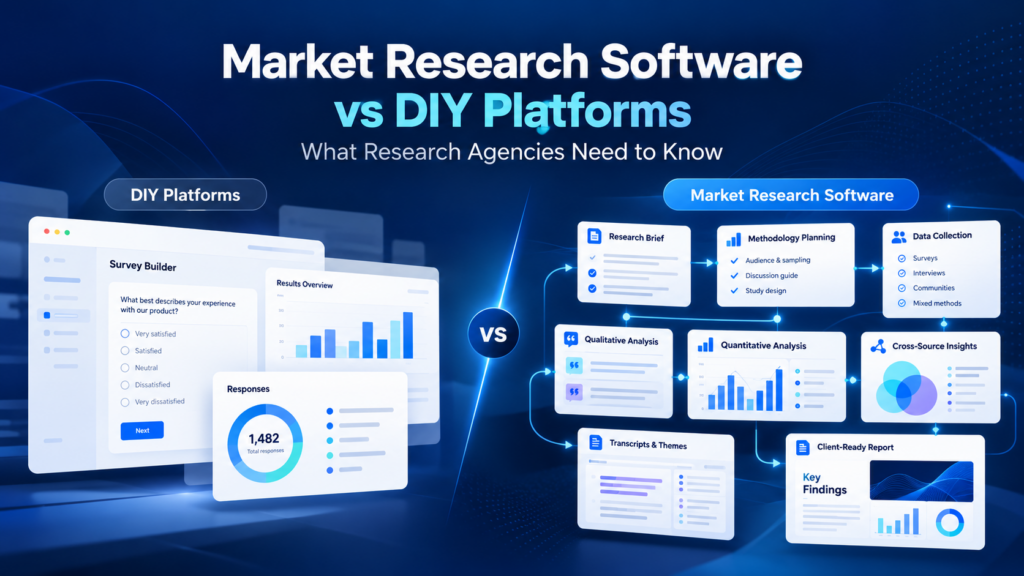
But a research agency does far more than launch surveys. It turns an incomplete client brief into a research plan, chooses the methodology, designs questionnaires and discussion guides, runs qualitative and quantitative work, analyses the results and delivers insight a client can act on. So agencies face a practical question: is a DIY research platform enough for the job, or does the work require dedicated market research software built for professional research workflows?
This guide explains the difference, where each option fits, and what agencies should look for before choosing a platform.
What Is Market Research Software?
Market research software is any tool that supports one or more stages of a professional research project. Depending on the product, that can include research planning, survey design, data collection, qualitative research, quantitative analysis, reporting, dashboards and workflow automation.
No single platform does all of these equally well. Some market research software tools focus on survey programming and fieldwork. Others specialise in statistical analysis, qualitative coding or reporting. A smaller group aims to connect the whole project, from brief to debrief, so each stage feeds the next.
The category is also growing fast. ESOMAR’s Global Market Research 2025 report puts the research software sector at US$62 billion in 2024, having grown 11.5% that year, compared with 4.8% growth for the established market research sector. That pace of growth helps explain why the distinction in this article matters.
What Are DIY Research Platforms?
DIY research platforms let a business team run certain research activities without outsourcing the whole project. Typical functions include creating surveys, distributing questionnaires, collecting responses, accessing online panels, basic dashboards and simple reporting.
Capabilities vary a great deal from one platform to the next. What they have in common is that they are designed for speed and self-service, usually with template methods and standard outputs.
That is not a criticism. Clients have used DIY tools and in-house teams for simple research for more than twenty years, and AI is accelerating the trend. For simple, fast and clearly defined questions, a DIY research platform is often the right answer.
Market Research Software vs DIY Research Platforms
The two categories overlap, and individual products blur the lines. As a general guide, though, they differ in the following ways.
| Area | Market research software | DIY research platforms |
| Typical user | Researchers and agencies | Internal teams and brands |
| Research complexity | Simple to advanced | Usually simple to moderate |
| Methodology | Greater flexibility | More standardised |
| Analysis | Can support advanced analysis | Often simpler analysis |
| Workflow | Can cover multiple research stages | Often focused on individual tasks |
| Reporting | Research- and client-focused | Often dashboard- or template-based |
| Best fit | Professional research workflows | Quick self-service projects |
Treat this as a starting point rather than a verdict. Some DIY platforms offer sophisticated analysis, and some professional tools are narrow. The useful question is not which label a product carries, but which parts of your workflow it genuinely supports.
Where DIY Research Platforms Work Well
DIY research earns its place when the question is simple and the stakes are low. Good examples include:
- Simple customer feedback
- Quick pulse surveys
- Straightforward concept checks
- Basic internal research
- Small projects with limited methodology requirements
In each case, the method is already clear, the analysis is basic and speed matters more than depth. Paying for more capability than the work needs makes little sense.
Where Research Agencies Need More
Agency work becomes harder to support with self-service tools once a project informs a decision that is difficult or costly to reverse: a product launch, a brand repositioning, a new market entry or a pricing overhaul. When the commercial stakes are high, speed alone is not enough; methodology, analysis and confidence in the evidence matter more.
Turning a Client Brief into a Research Plan
Briefs are often incomplete, and the stated request is not always the real business question. Experienced researchers treat a brief as a starting hypothesis rather than a fixed instruction. They work out what decision the client faces, what is already known and which methodology will actually answer the question. A DIY survey builder starts after those decisions have been made.
Designing More Complex Research
Strategic projects need sophisticated questionnaires, rigorous screeners, qualitative discussion guides, sampling plans and often mixed methods. The details determine whether a study works: whether a scale differentiates meaningfully between respondents, whether question order primes the next answer, and whether quotas hold together. A flawed instrument can look just as convincing as a sound one on the page, and problems often surface only during fieldwork or analysis, when they are expensive to fix.
Analysing More Than Basic Survey Results
This is where market research analysis software matters most. Agencies routinely work with open-ended responses, interview transcripts, survey datasets, prior tracker waves and the client’s own documents, all on the same project.
Under tight deadlines, analysts may struggle to review every source with equal depth. Good analysis software can help researchers examine transcripts, open-ended responses, survey datasets and other project materials as a joined-up evidence base, identify patterns and themes, and compare findings across data types. The researcher then decides which patterns matter and how they should be interpreted.
Producing Client-Ready Outputs
Clients do not pay for sixty charts. They pay for a clear story: what was learned, why it matters and what to do next. Agencies need tools that help turn data into recommendations, with a clear trail back to the evidence if a finding is challenged.
What Research Agencies Should Look for in Market Research Software

Use this checklist when comparing products. It applies whether you are looking at an analysis tool, a survey platform or an end-to-end system.
- Workflow coverage. Does the software support multiple stages of the research project, or just one? Tools that connect stages avoid copying information between systems.
- Qualitative and quantitative support. Can it work across both types of research where the agency needs it?
- Analysis capability. Can researchers move beyond simple charts and summaries to themes, segments and cross-source comparison?
- Researcher control. Can researchers review, edit and apply professional judgement at every stage? Can outputs be traced back to their source data?
- Collaboration. Can different members of the agency team work on the same project, with a record of who changed what?
- Reporting and outputs. Can research be turned into clear, client-facing insight rather than raw tables?
- Integration and flexibility. Does it work alongside the agency’s existing market research tools, such as survey platforms, panel partners and reporting software?
Add one more question for any tool that handles client data: security. Client vendor assessments increasingly ask where data goes, who can access it and whether it is used for model training. Look for recognised security controls or certifications, clear data-processing terms, and contractual confirmation that client and respondent data will not be used to train shared models. That confirmation belongs in the contract, not the sales pitch.
How AI Is Changing Market Research Software
AI is now used to reduce repetitive research work, for example:
- Summarising background information and desk research
- Assisting questionnaire and discussion guide development
- Coding open-ended responses
- Identifying themes across transcripts
- Analysing large or mixed datasets
- Supporting report structure and drafting
The time savings can be significant. Insightology reports that agencies using specialist research AI can complete projects up to 50% faster across proposals, fieldwork preparation and analysis. But how the AI is built matters as much as whether it is there.
Generic AI assistants are designed for broad language tasks rather than specialist research workflows. They can produce plausible-sounding output without consistently applying research methodology or maintaining the full context of a project. Research-specific tools reduce that risk by building research logic, project context and researcher review into the workflow, so there is a golden thread from the brief to the debrief.
Either way, the principle holds: the researcher leads and the AI supports. AI can be highly effective at execution, but framing the question, interpreting the evidence and standing behind the recommendation remain human responsibilities.
DIY Platform or Agency-Focused Software: Which Should You Choose?
Neither option is universally better. The right choice depends on the work.
A DIY platform may be enough if:
- The project is simple
- The methodology is already clear
- Analysis requirements are basic
- The team needs quick self-service research
More specialised market research software may be better if:
- Multiple research stages need support
- Projects combine qual and quant
- The methodology is complex
- Advanced analysis is required
- Outputs need to be client-ready
- The organisation runs research projects repeatedly
A quick way to decide is to look at your last twenty projects. If most were quick-turn tests and trackers, keep things simple. If most informed high-stakes decisions with several stakeholders, your tools need to match that work.
Final Thoughts
DIY platforms have made simple research far easier, and they will keep bringing more routine work in-house. Research agencies have different requirements because they own the methodology, execution, analysis and client relationship.
The right market research software should make those workflows faster without removing researcher judgement. It should take on the repetitive production work so your team can spend more time on the thinking clients actually pay for.
See how Insightology supports market research agencies across the research workflow, from the initial brief through analysis and client-ready insights.
FAQs
What is market research software?
Market research software is any tool that supports stages of a professional research project, such as research planning, survey design, data collection, qualitative and quantitative analysis, and reporting. Some products focus on one stage, while others connect the whole workflow from brief to debrief. Researchers and agencies use it to deliver reliable insight more efficiently.
What is the difference between market research software and survey software?
Survey software mainly focuses on creating questionnaires and collecting responses. Broader market research software may also support research planning, methodology, qualitative analysis, cross-source analysis and client reporting. Survey software is one type of research tool; market research software can cover several stages of a project.
Can market research agencies use DIY research platforms?
Yes. Many agencies use DIY platforms for specific tasks, such as quick pulse surveys or panel access. Complex strategic projects usually need additional specialist tools and experienced researcher input for methodology, analysis and interpretation.
How is AI used in market research software?
AI is used for questionnaire support, coding open-ended responses, theme identification, analysis of large datasets, summarisation and report drafting. The best tools keep researchers in control, with outputs that can be reviewed, edited and traced back to the source data.
Only pay
when you win
Get the AI market research platform your team needs. For Free.
Proposals stay free, so you don't pay for the groundwork. You'll only pay for completed projects.
Related articles
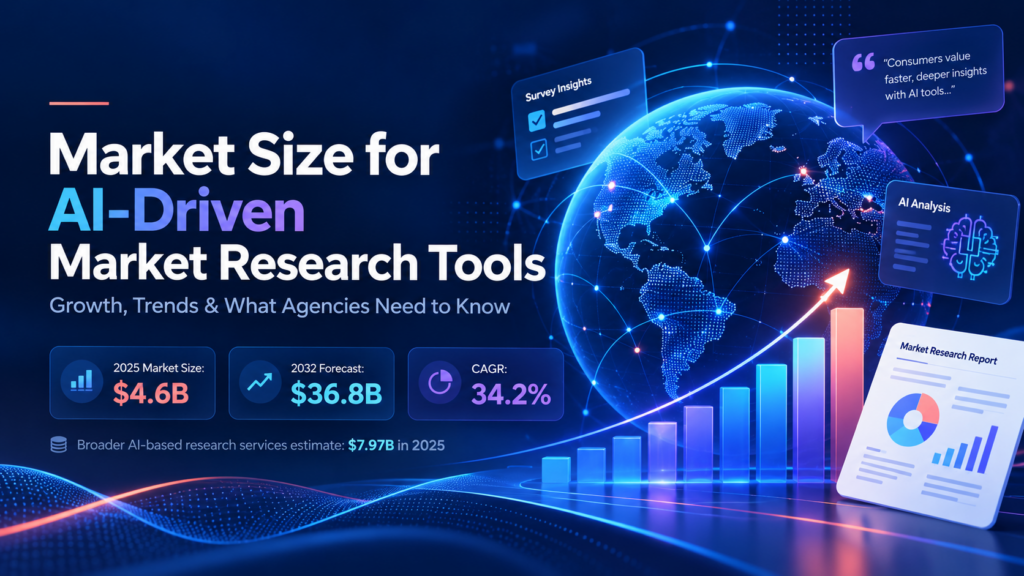
Market Size for AI-Driven Market Research Tools: Growth, Trends and What Agencies Need to Know

AI has moved from experiment to everyday practice in market research. Researchers now use it to draft surveys, analyse qualitative data, code open-ended responses, review interview transcripts, structure reports and automate repetitive research tasks. Demand for AI tools for market…

AI vs Manual Qualitative Coding: How Much Time Can AI Save in Survey Research?
Many research projects move quickly through fieldwork and then slow down. Hundreds of open-ended responses arrive, or a stack of interview transcripts, and someone has to make sense of them. Traditionally, qualitative coding means researchers read every response, identify themes,…

Will AI Replace Market Research Agencies? An Honest Answer
No — but it will replace agencies that treat it as a threat rather than a tool. AI is already replacing the execution layer of research: coding, cleaning, transcribing, formatting. What it cannot replace is judgment. The agencies that thrive…